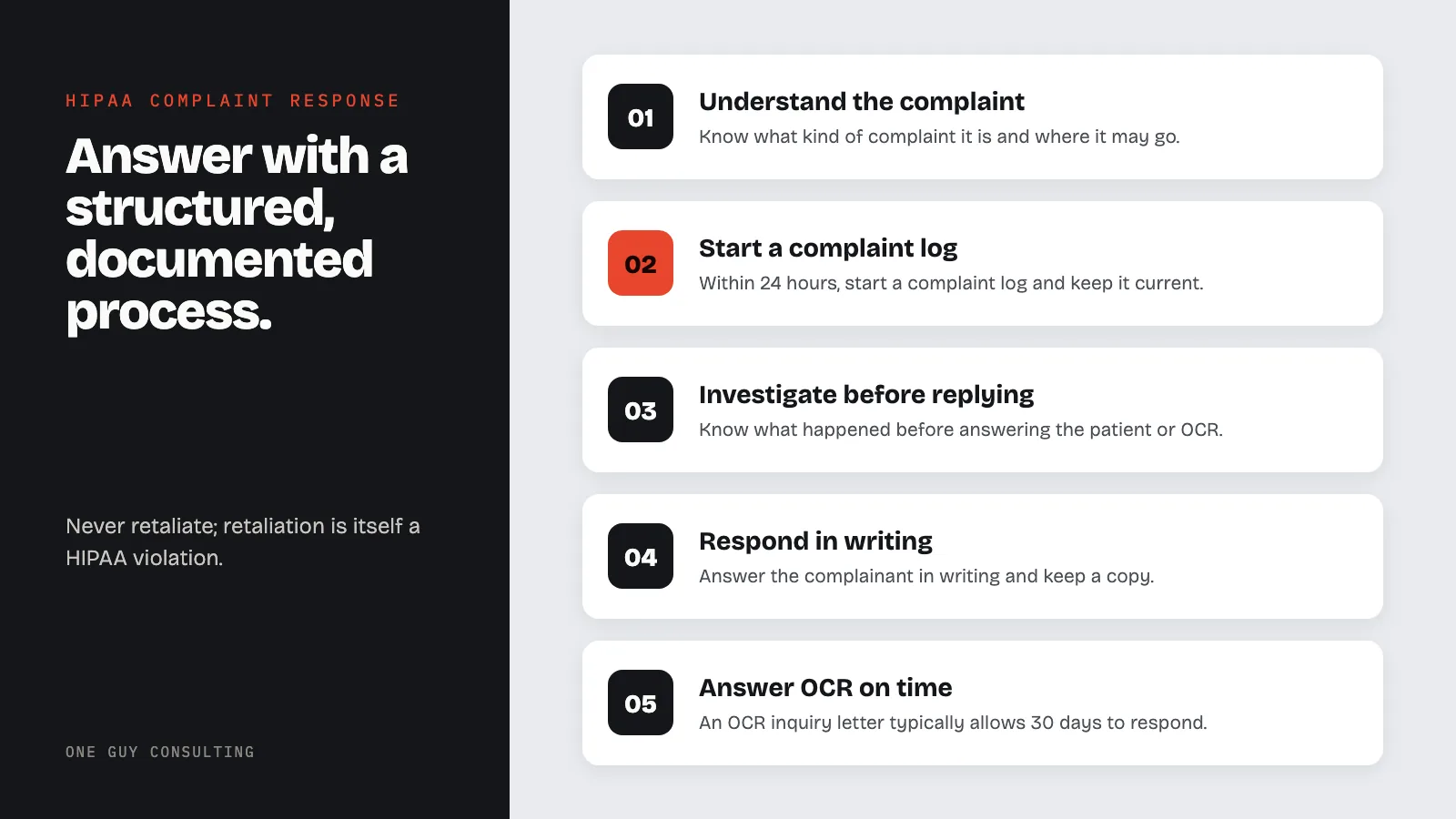
Respond to a HIPAA complaint by opening a complaint log, investigating internally before responding to anyone, and then answering the complainant or OCR (the HHS Office for Civil Rights, which enforces HIPAA). When OCR sends a letter about the complaint, respond in writing by the date the letter gives. Never retaliate against the complainant; under 45 CFR 164.530(g), retaliation is itself a HIPAA violation.
If a complaint has already been filed, whether by a patient directly to your office or through the HHS Office for Civil Rights, the first thing to understand is this: most HIPAA complaints do not result in fines. Of the 370,578 cases OCR had resolved by October 31, 2024, it settled or imposed a civil money penalty in 152, according to its enforcement highlights. In another 67,873 cases, OCR intervened early with what it calls technical assistance (essentially a structured conversation about what happened and how you are addressing it), without the need for an investigation. That does not mean the situation is trivial. It means that how you respond in the next few days and weeks will largely determine the outcome. This guide walks Privacy Officers through each stage of the complaint response process, from the moment you first learn of the complaint through an OCR investigation, if it gets that far.
Responding to a HIPAA Complaint: What Privacy Officers Must Do
There are two distinct scenarios you may be managing: an internal complaint filed by a patient or workforce member directly to your organization, and an external complaint filed with OCR. Both require structured, documented responses, but the stakes and timelines differ. This guide covers both, starting with the internal process, because how you handle an internal complaint often determines whether it escalates to OCR at all.
Step 1: Stay Calm. Understand What You Are Actually Dealing With
Before responding to anything, you need to know what kind of complaint you have received and what the likely trajectory is.
Since the Privacy Rule compliance date in April 2003, OCR has received over 374,321 HIPAA complaints (as of October 31, 2024, per its enforcement highlights). Most never reach a formal investigation. OCR found that 255,953 of its resolved cases were not eligible for enforcement (for example, OCR lacked jurisdiction, the complaint was untimely or withdrawn, or the activity did not violate the HIPAA Rules), and it resolved 67,873 more through early technical assistance. Civil money penalties and settlements are rarer still. This context matters because it shapes your response posture. You are not automatically facing a fine. You are facing a process, and the process rewards organizations that respond promptly, cooperate openly, and demonstrate that they take compliance seriously.
OCR reports the issues most often alleged in complaints, in order of frequency: impermissible uses and disclosures, lack of safeguards, lack of patient access, lack of administrative safeguards for electronic protected health information, and use or disclosure of more than the minimum necessary. Complaint types you may face include:
- Right of access failures: patients denied timely access to their medical records under the right of access (a patient's right to inspect and obtain a copy of their own protected health information, or PHI, under 45 CFR 164.524).
- Impermissible uses and disclosures: PHI shared without proper authorization or outside of a permitted purpose.
- Inadequate safeguards: insufficient physical, administrative, or technical controls protecting PHI.
- Lack of notice of privacy practices: failure to provide or post an adequate NPP.
- Retaliation against individuals for exercising their rights: a standalone violation under 45 CFR 164.530(g).
Knowing which category you are in helps you scope the investigation and assemble the right documentation quickly.
Step 2: Document Everything from the Moment You Learn of the Complaint
The single most important thing you can do in the first 24 hours is start a complaint log and keep it current. Document:
- The date and time you received notice of the complaint.
- The source (patient, workforce member, OCR letter, phone call).
- The nature of the alleged violation, in the complainant's own words where possible.
- The names of staff members involved or identified in the complaint.
- Any related records, communications, or system logs you are aware of at this stage.
- Every action your organization takes in response, with dates and the names of staff involved.
This log becomes your compliance record. If OCR opens an investigation, this documentation demonstrates that your organization responded in good faith and in a timely manner. Organizations that can produce a clear, contemporaneous response record are in a much stronger position than those reconstructing a timeline from memory six months later.
The log is not only good practice. The Privacy Rule requires it:
"As required by paragraph (j) of this section, a covered entity must document all complaints received, and their disposition, if any."
45 CFR 164.530(d)(2)
Keep that record. Under 45 CFR 164.530(j)(2), required documentation must be retained for six years from the date of its creation or the date when it last was in effect, whichever is later.
Designate a single point of contact for the complaint (typically the Privacy Officer) and route all communications through that person. This prevents inconsistent statements and ensures nothing gets lost across departments.
Step 3: Conduct an Internal Investigation Before Responding to Anyone
Do not respond to the complainant or to OCR before you understand what actually happened. Rushing to respond before you have the facts creates risk: you may contradict yourself later, or acknowledge something inaccurate that complicates your position.
A practical internal investigation includes:
Gather the relevant records. Pull the patient's access log, any correspondence related to the complaint, system audit logs, and training records for the involved staff. If the complaint involves a records request, document when the request was received, when it was fulfilled, and what format the records were provided in.
Interview involved staff members. Do this promptly, while memories are fresh. Use open-ended questions. Document the conversations. Make clear to staff that the purpose is fact-finding, not discipline, at this stage.
Review your policies and procedures. Was there a written policy governing the situation? Was staff trained on it? Was the policy followed, or was the policy itself the problem?
Determine the scope of any disclosure. If PHI was impermissibly disclosed, you need to know: what information was involved, how many individuals were affected, and whether the disclosure may trigger your HIPAA Breach Notification Rule obligations.
Assess what went wrong and why. Was this a systemic failure or an isolated incident? Was it a training gap, a process gap, or a technology gap? This assessment shapes both your response and your remediation plan.
In many cases, the internal investigation reveals that what happened was not technically a HIPAA violation, or that the scope was narrower than the complaint suggested. In other cases, it reveals a genuine gap that needs to be corrected regardless of what OCR does. Either way, you need the facts before you respond.
Step 4: Respond to the Patient or Complainant Appropriately
If the complaint came directly to your organization (not through OCR), you have an opportunity to resolve it at this level without regulatory involvement. Most patients who file complaints want one of three things: an acknowledgment that something went wrong, a correction of the underlying problem, or access to records they were denied. In many cases, providing what the patient actually needs is both the right thing to do and the most effective de-escalation strategy.
A few guidelines for responding to the complainant directly:
- Respond in writing, and retain a copy of your response.
- Acknowledge that the organization received the complaint and took it seriously.
- Do not admit to a HIPAA violation unless your legal counsel has reviewed the situation: phrases like "we regret any inconvenience" are very different from "we violated your HIPAA rights".
- If the complaint involves a records access request, fulfill it promptly under 45 CFR 164.524: patients generally must receive their records within 30 days, with one 30-day extension available.
- Describe any corrective action you are taking without making commitments you cannot keep.
Note that patients may simultaneously file a complaint with OCR even after receiving a response from your organization. OCR has the authority to investigate complaints regardless of whether the organization has already responded to the individual. Resolving the complaint with the patient does not automatically close an OCR complaint, but it is still the right move, and it gives you a documented good-faith resolution to show OCR.
Critical: Anti-Retaliation. Under 45 CFR 164.530(g) and 160.316, covered entities are prohibited from retaliating against any individual who files a complaint with HHS, participates in an investigation, or exercises any right under the Privacy Rule. This prohibition is absolute. Terminating, disciplining, intimidating, threatening, or otherwise acting against a patient or workforce member because they filed a complaint is itself a HIPAA violation, and one OCR takes seriously. Make sure every manager and supervisor involved in the situation understands this clearly.
Step 5: If OCR Contacts You (What to Expect and How to Respond)
When OCR receives a complaint, it first screens it for jurisdictional eligibility. Not all complaints make it past the screening stage. OCR does not pursue complaints that are untimely, complaints against entities that are not HIPAA covered entities or business associates, or complaints describing activity that does not violate the HIPAA Rules. Under 45 CFR 160.306(b)(3), a complaint must be filed within 180 days of when the complainant knew or should have known that the act or omission complained of occurred, unless this time limit is waived by the Secretary for good cause shown.
If the complaint survives screening, OCR may:
- Contact your organization by letter or phone to inform you of the complaint and request an initial response.
- Request specific documentation: policies, training records, audit logs, correspondence.
- Ask for a written description of your compliance program and how the situation was handled.
- Schedule an on-site review in more complex cases.
When OCR sends an initial inquiry letter, respond in writing by the date the letter gives. This is not optional: 45 CFR 160.310(b) requires covered entities and business associates to cooperate with OCR investigations. Your response should:
- Address each question OCR asked, specifically and completely.
- Provide copies of the requested documentation (not originals).
- Describe the facts of the situation as your investigation determined them.
- Describe any corrective actions you have taken or are in the process of taking.
- Be written in a professional, cooperative tone: OCR investigators respond better to organizations that engage constructively.
A practical approach is to have legal counsel review your OCR response before submission, particularly if the situation involves a potential breach, a pattern of similar complaints, or significant PHI exposure. This content is for educational and informational purposes only and should not be construed as legal advice.
HIPAA Complaint Deadlines at a Glance
These are the deadlines written into the regulation. OCR's own letter sets the date for your reply to OCR, so check that letter first.
| Deadline | What it covers | Source |
|---|---|---|
| 180 days | A complaint to OCR must be filed within 180 days of when the complainant knew or should have known of the act, unless the Secretary waives the limit for good cause. | 45 CFR 160.306(b)(3) |
| 30 days, plus one extension of up to 30 days | Acting on a patient's request for access to records. An extension needs a written statement of the reason for the delay and the completion date, given within the first 30 days. | 45 CFR 164.524(b)(2) |
| 60 calendar days | Notifying affected individuals of a breach, without unreasonable delay and no later than 60 calendar days after discovery. | 45 CFR 164.404(b) |
| Six years | Keeping the complaint log, its disposition and other required documentation. | 45 CFR 164.530(j)(2) |
The OCR Investigation Process: What Actually Happens
If OCR proceeds past the initial inquiry, the investigation typically follows a predictable pattern. Understanding the stages helps you prepare documentation in advance rather than scrambling under deadline pressure.
Data request. OCR will ask for specific records. Common requests include your Notice of Privacy Practices, workforce training records, relevant policies and procedures, the risk analysis and risk management plan, documentation of workforce sanctions for prior violations, and any audit logs related to the complaint. Organizations that maintain well-organized compliance documentation can respond to these requests efficiently. Organizations that have never conducted a formal risk assessment or cannot produce training records are immediately at a disadvantage.
Interviews and on-site reviews. In more complex investigations, OCR investigators may request to speak with the Privacy Officer and other involved staff, or conduct an on-site visit to review your facility and operations. On-site reviews are more common in larger investigations or where OCR has reason to believe systemic violations are present.
Resolution options. OCR investigations resolve in one of several ways:
- Technical assistance: OCR gives guidance and the organization corrects the issue informally. Under 45 CFR 160.304(b), OCR may provide technical assistance to help organizations comply voluntarily.
- Voluntary compliance: OCR identifies a compliance gap and the organization corrects it without formal action.
- Resolution agreement: a settlement in which the organization agrees to perform certain obligations and make reports to HHS, generally for three years, according to HHS. It may include a payment (the resolution amount), and HHS monitors compliance during the term.
- Corrective action plan (CAP): the list of required fixes, usually attached to a resolution agreement, with reporting to OCR over a set term (one year for Family Dental Care and two years of monitoring for URMC, both described below).
- Civil monetary penalties (CMPs): Formal financial penalties imposed after OCR determines violations and the organization does not reach a resolution agreement. CMPs are rare: as of October 31, 2024, OCR reported 152 cases in total that it had settled or resolved with a civil money penalty.
Many of the largest enforcement actions, those resulting in million-dollar penalties, have involved organizations that failed to conduct a risk analysis, failed to implement basic access controls, or had a demonstrated pattern of ignoring compliance requirements. A single complaint that is investigated and resolved cooperatively very rarely reaches CMP territory.
Your Documentation Is Your Defense
Throughout an OCR investigation, the organization's documented compliance program is its strongest asset. Specifically, OCR looks for evidence of:
- A completed and current risk analysis (45 CFR 164.308(a)(1)(ii)(A)). OCR runs a dedicated Risk Analysis Initiative that focuses investigations on this requirement.
- A risk management plan that addresses identified risks.
- Written policies and procedures that cover the area at issue in the complaint.
- Workforce training records showing that relevant staff were trained on the applicable policies.
- A sanction policy for workforce members who violate HIPAA.
- A process for accepting, evaluating, and resolving privacy complaints internally (45 CFR 164.530(d)).
- Documentation of any prior complaints and how they were resolved.
Organizations that can produce this documentation quickly signal to OCR that compliance is taken seriously and that the complaint may represent an isolated incident rather than a systemic failure. Organizations that cannot produce basic documentation (particularly a risk analysis) will face significantly more scrutiny, regardless of what the original complaint was about.
I have seen how quickly that documentation can come together under pressure. A mental health franchise office in Florida I worked with had policies that were never written, records with holes, and staff training half done, with a state auditor due in days. A ranked action plan and daily check-ins got the office audit-ready in under a week, and it passed its state audit. That was a state audit, not an OCR complaint, but the lesson is the same: the record you can produce decides how the review goes. Read Case 01.
If you identify gaps during the investigation process, address them immediately and document that you did. Demonstrating active remediation during an OCR investigation is viewed positively. The Enforcement Rule says the Secretary will, to the extent practicable, seek the cooperation of covered entities and business associates in obtaining compliance
(45 CFR 160.304(a)), and may resolve noncompliance by informal means
(45 CFR 160.312(a)(1)). Showing that you are fixing the problem is exactly what OCR wants to see.
For organizations that have not yet conducted a formal risk assessment, see our guide on how to conduct a HIPAA risk assessment. Getting one in place before or during an investigation significantly improves your position.
Right of Access Complaints: A Special Note
Because right of access is the subject of a dedicated OCR enforcement initiative, it deserves specific attention. Under 45 CFR 164.524, patients have the right to inspect and receive a copy of their PHI within 30 days of a request (with one 30-day extension if written notice is provided). Organizations may charge a reasonable, cost-based fee (45 CFR 164.524(c)(4)). They must mail the copy if the patient asks (164.524(c)(3)(i)), and if the records are kept electronically and the patient asks for an electronic copy, they must provide one in the requested form if it is readily producible, or in another readable electronic form agreed with the patient (164.524(c)(2)(ii)).
OCR announced its Right of Access Initiative as an enforcement priority in 2019, and by September 2022 the effort had reached 41 cases, including three dental practices announced that month. Many of these cases are simple delays. In August 2026, OCR announced a settlement with Azul Vision, Inc., an optometry and ophthalmology provider with 31 clinics in California, which agreed to pay $50,000 after a patient who requested her records on January 9, 2023 did not receive them until January 6, 2025.
If your complaint involves a records access request, fulfill it immediately, even if the complaint is already filed. Provide the records as quickly as possible, document that you did, and note the timeline in your response to OCR. Demonstrating that the issue was resolved promptly after you became aware of it is important.
Enforcement Examples Worth Knowing
A few published enforcement cases illustrate how OCR approaches complaints and what organizations can learn from them:
In 2022, OCR settled with Family Dental Care, P.C., a dental practice in Chicago, Illinois. A former patient requested her complete records on May 8, 2020, and the practice did not produce all of them until October 12, 2020. After she complained to OCR, the practice agreed to pay $30,000 and follow a one-year corrective action plan, all from a single complaint. The core issue was not a complex technical violation. It was a straightforward failure to fulfill a records request in a timely manner.
In 2019, the University of Rochester Medical Center (URMC), one of the largest health systems in New York State, agreed to pay $3 million and take corrective action that includes two years of monitoring. URMC had filed breach reports with OCR in 2013 and 2017 after losing an unencrypted flash drive and having an unencrypted laptop stolen. OCR found that URMC had failed to conduct an enterprise-wide risk analysis, and noted that it had already investigated a similar lost flash drive at URMC in 2010 and provided technical assistance.
The pattern in high-penalty cases is consistent: penalties escalate when OCR finds that the organization lacked fundamental compliance infrastructure, not merely that a single incident occurred. A complaint is a bounded problem. A compliance program failure is a systemic one, and OCR responds accordingly.
FAQs
How long does OCR have to investigate a HIPAA complaint?
The HIPAA Enforcement Rule (45 CFR Part 160, Subpart C) sets no deadline by which OCR must complete an investigation. Investigations can take months or, in complex cases, years. The 180-day deadline applies to the complainant: under 45 CFR 160.306(b)(3), a complaint must be filed within 180 days of when the complainant knew or should have known that the act or omission complained of occurred, unless the Secretary waives this time limit for good cause shown. Once a complaint is filed, OCR proceeds on its own timeline.
Can a patient file a HIPAA complaint directly with OCR after complaining to the organization?
Yes. Patients may file with OCR at any time within the 180-day window, regardless of whether they also complained directly to your organization. A patient who received a satisfactory response from your organization may still file with OCR, and OCR has the authority to investigate. Resolving the complaint with the patient is the right thing to do, but it does not foreclose an OCR complaint.
What is the first thing a Privacy Officer should do when a complaint is received?
Open a complaint log and document everything you know immediately. Before responding to anyone (the complainant, OCR, or your own staff outside the investigation team), gather the facts through an internal investigation. Responding before you understand what happened creates more risk than taking a few days to investigate thoroughly.
Does having a compliance program in place actually affect the outcome of an OCR investigation?
Yes, significantly. When OCR sets a civil money penalty, 45 CFR 160.408 lists the factors it considers, including the organization's history of prior compliance, whether it has attempted to correct previous indications of noncompliance, and how it has responded to prior complaints. Organizations with a current risk analysis, written policies, and workforce training records are in a far stronger position in OCR investigations than those without. The documentation does not guarantee a favorable outcome, but its absence almost always makes the outcome worse.
What should we do if we realize we have a reportable breach during the complaint investigation?
Report it. The Breach Notification Rule (45 CFR 164.400–414) requires covered entities to notify affected individuals without unreasonable delay and in no case later than 60 calendar days after discovery of a breach (164.404(b)), notify HHS (164.408), and, for a breach involving more than 500 residents of a State or jurisdiction, notify prominent media outlets serving the State or jurisdiction (164.406(a)). Discovering a breach during a complaint investigation does not suspend these timelines. Attempting to conceal a reportable breach would be a far more serious problem than the original complaint. For a detailed breakdown of breach response obligations, see our guide on HIPAA Breach Notification Rule compliance.
Can OCR investigate issues beyond the scope of the original complaint?
Yes. Once OCR opens an investigation, it may expand the scope if it finds evidence of additional violations or systemic compliance failures. This is one reason why having a complete and organized compliance program matters so much: an investigation triggered by a single access complaint can expand significantly if OCR finds that the organization has no risk analysis, no training records, or a pattern of unremediated violations.
What does a corrective action plan require?
Corrective action plans (CAPs) vary based on the violations identified, but typically require the organization to implement specific policies or technical controls, provide workforce training, conduct periodic risk analyses, and submit reports to OCR during the agreement's term, which HHS says is generally three years. CAPs are negotiated and are generally less financially severe than civil monetary penalties, but they create ongoing reporting obligations and require sustained compliance attention. For organizations facing a CAP, the compliance infrastructure required is essentially what a complete HIPAA program should already include.
Receiving a HIPAA complaint, whether directly from a patient or through OCR, is manageable when you respond with a structured, documented process. The organizations that end up with the largest penalties in OCR's published enforcement actions are rarely there because of a single mistake. They are there because they lacked the documentation, the policies, or the internal processes to demonstrate that they take HIPAA seriously.
The best time to build that infrastructure is before a complaint arrives. The second best time is right now.
One Guy Consulting helps healthcare organizations build practical HIPAA compliance programs (from risk assessments to policies and procedures to workforce training) that hold up when it matters most. Book a free 30-minute intro call to see how we support Privacy Officers at every stage of compliance.
Key stat: Since April 2003, OCR has received over 374,321 HIPAA complaints and has settled or imposed a civil money penalty in 152 cases (as of October 31, 2024). Under 45 CFR 160.306(b)(3), a complaint must be filed within 180 days of when the complainant knew or should have known that the act or omission complained of occurred, unless the Secretary waives this time limit for good cause shown.
One Guy Consulting in 37 Seconds
Sources
- HHS OCR: How to File a HIPAA Complaint.
- HHS OCR: Resolution Agreements and Corrective Action Plans.
- HHS OCR: HIPAA Right of Access Initiative.
- HHS OCR: Three Right of Access Cases with Dental Practices (September 2022).
- HHS OCR: Family Dental Care, P.C. Resolution Agreement and Corrective Action Plan.
- HHS OCR: Azul Vision, Inc. Resolution Agreement and Corrective Action Plan.
- HHS: Failure to Encrypt Mobile Devices Leads to $3 Million HIPAA Settlement (URMC, 2019).
- HHS OCR: Health Fitness Corporation Settlement (Risk Analysis Initiative).
- 45 CFR 160.306: Complaints to the Secretary.
- 45 CFR 164.524: Access of Individuals to Protected Health Information.
- 45 CFR 164.530: Administrative Requirements (Privacy Rule).
- 45 CFR Part 164, Subpart D: Notification in Case of Breach of Unsecured PHI.
- HHS OCR: HIPAA Enforcement Highlights.
Related Reading:
- HIPAA Breach Notification Rule Compliance.
- HIPAA Compliance Checklist for Small Practices.
- HIPAA Fines Increased: 2026 Penalty Amounts.
Related reading: OCR Program Guide for Audits
Try three One Guy Consulting 3D staff training courses free →